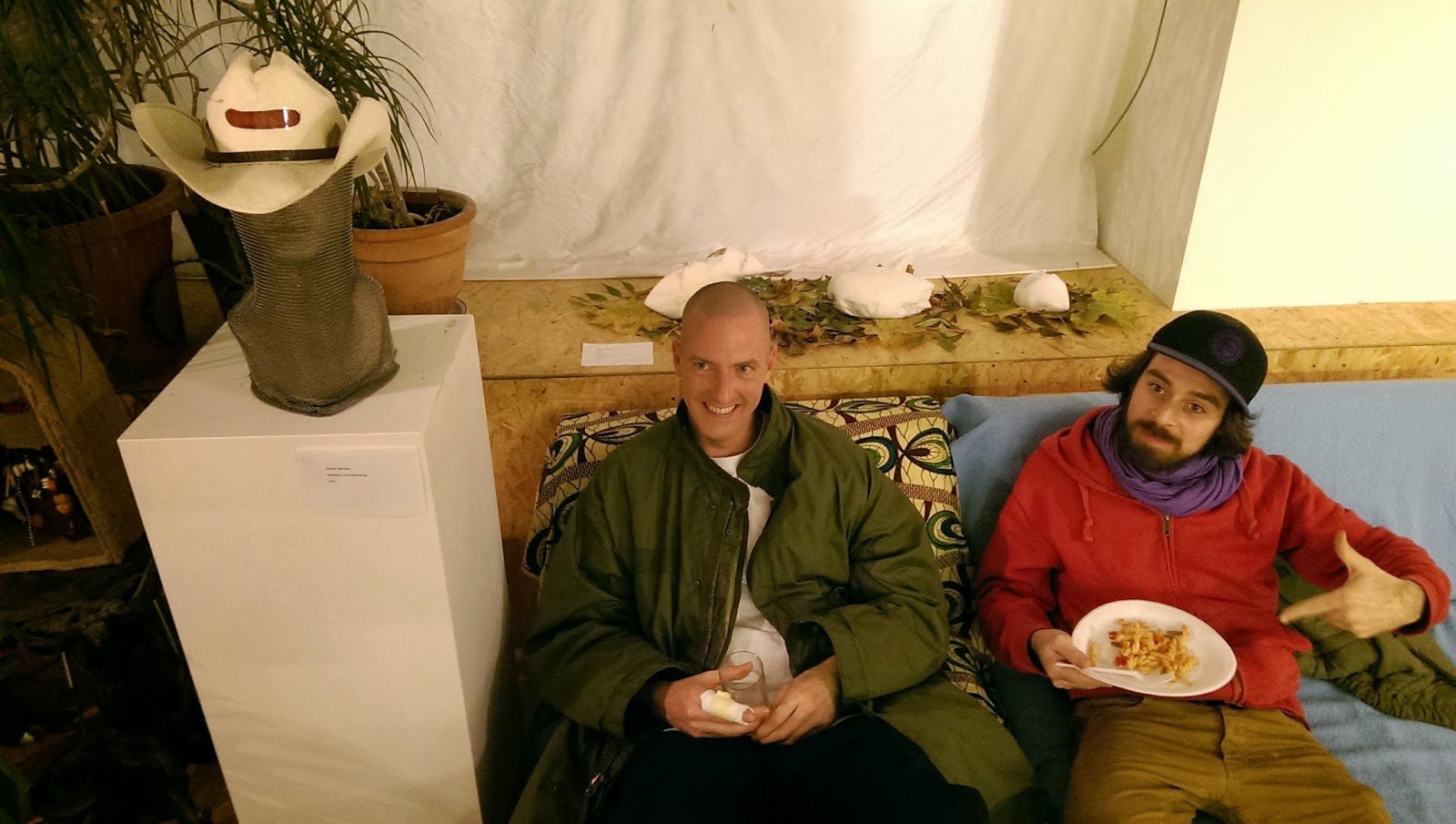
Participation is an idea which is intensely worked on in Stuttgart-Nord. A few places of participation and by far not all of them are:
- Three "KiFaze" (german, short for kids- and family-center) which invite families for Cafés, workshops, play groups or just to hang around. They often provide counseling for all kinds of problems like school, parenting, health care and so much more.
- Haus 49, and the Kinder- und Jugendhaus Kirsten Maiba manages right now, both centers especially for the youth of Stuttgart-Nord. They worked on the great project "Nord - Ein Stadtteil dreht sich" last summer which is worth its own post!
- Christian and muslimic churches are visible in their work; of course on several annual celebrations, but also for example on the annual Jugendkirchefestival.
- Aside from the social aspects there are also associations which provide participation in the cultural area like turkish or armenian dance cooperations.
- There is the association Infoladen Stuttgart 21 which provides information about the changes coming with the huge construction project Stuttgart 21.
- Because of the uprising of the Urban Gardening movement, two projects came to life: the Stadtacker Wagenhallen and the Nordlichtung. This is also a topic for an own post, because since this summer, there exists a municipal management for urban gardening in Stuttgart.
Last, but not least, there is us, the glocal neighbours. This group is special, because its members are not defined by a common background. By including social workers, artists and residents from two (different) neighbourhoods (and cultures), the group has not only to define its potential but also its actual topics and tasks.
And now, I come to the Picnic Principle of Participation. A good picnic thrives if everyone coming brings something. This something is not only food and drinks but also music, ideas for interesting games and conversations. Like this merry group where someone even brought a boat:
The point is, that there is no top-down structure in a picnic. In contrast, the social, religious and cultural centers and associations in the list above provide a place, a program, an infrastructure and then invite the people to participate. Some projects are not realizable if there are not enough participants. For someone to participate you have to have a distinctive interest or topic, sometimes even a distinctive mind-set.
Whereas with the Picnic Principle you follow a different approach by installing other structures in a participation project.
- Not only do you provide a bottom-up approach because everything is chosen and brought by the group.
- Also, you appreciate contributions which are not comparable on a common basis with each other: Each contribution is equally valuable.
- Third, you do not need a certain group size: Your project should work with two people or with fifty.
- At last, you don't expect a certain outcome but trust the potential of the group.
I admit that the Picnic Principle has probably its limits. But I like the idea and I think the glocal neighbours are a good space to try it out.
-by Liv